


Headhunters regularly claim they recruit rock stars, but most executive recruiters have never known a rock star in the literal sense. Consequently, they haven’t a clue what it takes to perform at that level — at the very top — whether in a stadium filled with fans or the boardroom.
If you think about it, few executive recruiters have recruited candidates who would qualify as icons. Rock stars are unicorns. They are rare, if not magical, beings. Headhunters who’ve met the real thing get that. To recruit at that level, a recruiter needs to operate at that level. The more time you spend with champions in any profession, the more capable you become of recognizing exceptional talent in candidates on the verge of reaching the top.
Why Knowing Actual Rock Stars is Relevant
For the few of us who have gotten to know real rock stars, the experience informs our understanding of the qualities that compel executives and technologists to outperform everyone else. Real rock stars have taught me how to recognize the special mix of skills and abilities required to rise to the very top. I have been fortunate to get to know legendary musicians so iconic that other rock stars write about them.
Why Recruit Rock Star Executives?
Executive recruiters seek “rock star” candidates to help the business be more successful. Startups backed by top-tier venture capital firms require that level of performance to scale. Marquis names attract investors so they don’t run out of runway (money) and great talent.
Business rock stars are often so charismatic that they are worshiped. Steve Jobs inspired the cult of Mac, and to this day, he remains a source of inspiration in design and business. Jobs made it a practice to recruit A-Players to his executive team. Jobs contended that if you recruit B-quality talent, they hire C-quality direct reports to make themselves look better. Soon, you’ll set off a Bozo Explosion.
Headhunters make it a practice to recruit rock stars because the top performers have a way of getting even better, as the Harvard Business Review reports. They use competition to hone their skills and constantly reinvent themselves to stay ahead of the pack.
“Star players focus on what they can control and forget the rest. They’re masters of compartmentalization.”
— Graham Jones, Professor of Elite Performance Psychology at the University of Wales
Star Players Focus
I’ve witnessed that relentless focus firsthand. Though he is a humble guy, my husband, Crispin Cioe, is a renowned saxophonist. To get to that level, one has to woodshed (practice). With few exceptions, Crispin has practiced every day I’ve known him. He shows up no matter what. I don’t believe I’ve ever heard him complain. (How is that possible?) I honestly don’t know how he does it.
They Practice
His work ethic is intrinsic: he simply wakes up that way. Every day, he doggedly shows up to discover ways to do what he does better. And it gives him joy. Crispin’s daily routine leverages the mind’s ability to run programs (habits) without conscious thought. (On that latter point, I highly recommend the book, The Power of Habit: Why We Do What We Do in Life and Business.)
I Met My Husband at Keith Richard’s House
I started dating Crispin after bumping into him at Keith Richards’s home in Weston, Connecticut. Before that, when I lived in Boston, I became friends with members of the J. Geils Band. My husband toured with J. Geils as part of the Uptown Horns. Crispin also played with members of Aerosmith. So when the J. Geils Band and Aerosmith, Boston’s top rock ‘n’ roll bands, played Fenway Park for the first time — front-page news in Boston. The Bad Boys of Boston gig was reported in Rolling Stone magazine. I was there. I hung out backstage and in a guest section up front, taking photos while Crispin did his sax thing:


Famous Musicians Have Always Been In My Life
Before I got married, I lived across the street from Jimmy Seals of Seals & Crofts, who would come over and play the piano in my living room. Next door to him was legendary session musician and guitarist Louie Shelton. (Check out his solos in Last Train to Clarksville and Hello.)
I was an investigative reporter and TV journalist at the time — not a musician — yet music kept popping into my life. It gave me glimpses of real genius.
Crispin Has Toured with The Rolling Stones
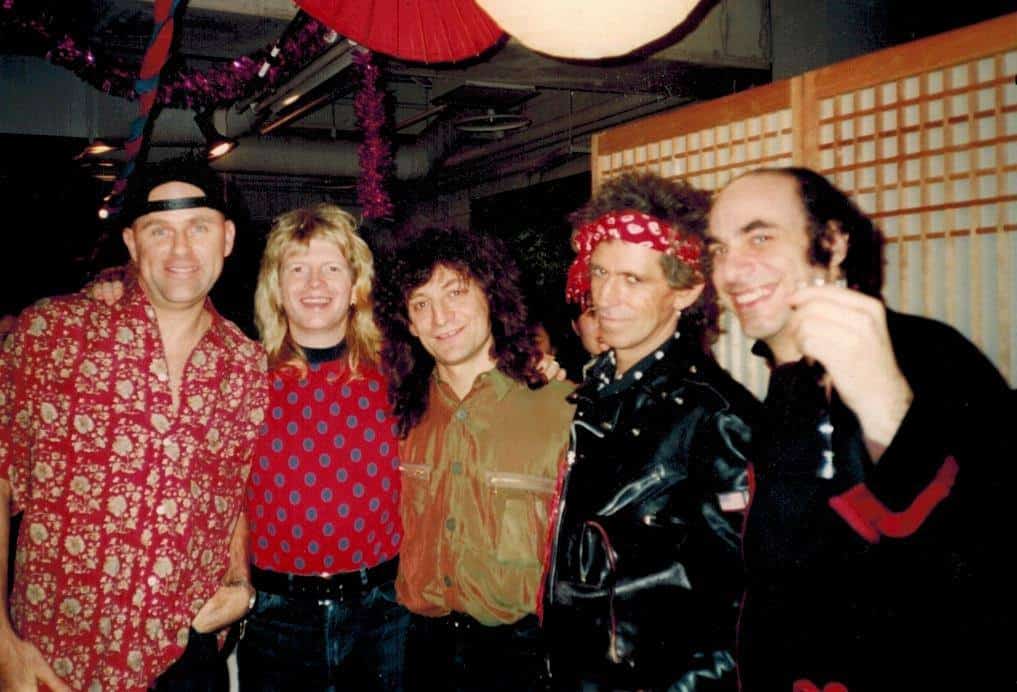
My husband Crispin Cioe (the guy in the middle in the photo below) has not only toured with rock stars that include The Rolling Stones, he’s played on more than 600 albums and is part of the famed horn section called The Uptown Horns. He’s scored motion pictures. (See Burnzy’s Last Call.) He’s composed and recorded his own music with his band Cracked Ice. (See Cracked Ice’s Soul Noir.) He has served as music director for the Mark Twain Prize for Comedy on PBS. (See Jimmy Fallon’s U2 sendup, Beautiful Fey, and Jack Black’s School of Rock rendition of Queen’s We Will Rock You.) He’s played with Aretha Franklin, James Brown, and Coldplay. The list goes on.
Between the two of us, we have spent a lifetime studying what it takes to be iconic.
What It Takes to Be a Rock Star
Research indicates it is virtually impossible to predict how successful a candidate will be once they’re hired. But might there be a way to determine a rock star in the making? There are obvious qualities and not-so-obvious characteristics that, when combined, produce a rock star.
Talent That Defies Logic
Rock stars have talent that far surpasses mere mortals — so much so that it defies logic. They pick up an instrument at the age of 5 and inexplicably know how to play it. In the documentary series The Beatles: Get Back, you see Paul noodling on the guitar in the studio, and you witness the songs you’ve known and loved your whole life take shape before your eyes. The series captures the genesis of The Beatles’ hit songs released on the albums Abbey Road and Let It Be. It is thrilling to behold. Gifted technologists and executives who become luminaries have a similar riveting quality. They become Zeus, capturing lightning in their bare hands.
Vision They Summon Into Being
Rock stars summon their lives into being. The vast majority knew they would become stars at the outset or the best at what they did. Or they already thought of themselves as a star and stuck with it long enough until everyone else realized the same thing. Or, like my husband, he couldn’t imagine doing anything else. In his 20s, he persisted through hardship, living over a Portuguese restaurant in Somerville, Massachusetts, that cooked a lot of fish. The apartment reeked of it. He’d told me he would trudge through the New England snow to get to the Berkeley School of Music because he couldn’t afford bus fare. But though we’ve been married for decades, I just learned he lived in the apartment without a bed. It was just Cris, his saxophone, and a lawn chair. Yet, he was determined and happy.
Discipline Required for Mastery
Rock stars put in the time to perfect their craft so that when it comes time to walk on stage, they don’t have to be up in their head and think when they perform. The music flows. Clocking Malcolm Gladwell’s 10,000-hour rule makes a difference. Malcolm Gladwell cites The Beatles as a prime example. The band played in Hamburg, Germany, between 1960 and 1962, performing over 1,200 times for roughly 10,000 hours. By the time they were rock stars, they were fully formed musically.
Peak-Performance Ability
Have you ever been so engrossed in work that you lost track of time? That is called a state of flow, a type of concentration that enables peak performance and ephiphanies. Rock stars are masters of flow, the most productive and creative state of mind for work. Renowned rock stars often structure their lives channel their inner muse.
Quantum Simplification
Rock stars simplify the complex. A rock star technologist can distill thousands of lines of code into a single expression. Steve Jobs simplified Apple’s product line and product design. Miles Davis could fill a room with a single note. The best are inherently minimalistic. Their leaps of creativity shed what is unnecessary so that what remains is inspired work.
Unstoppable Work Ethic
Rock stars are like the Energizer Bunny. They keep going and going. They don’t call in sick. On a tour, they show up unless they’re hospitalized. Beyoncé is renowned for a relentless work ethic. She often practices for 9 hours a day, trains 5 times a week, and is known for obsessive rehearsal and attention to detail. The best of the best regularly clock long hours without complaint.
Limitless Persistence and Grit
Grit and persistence define the best talent. They get up when they are knocked down. They rise when they fall. And when people tell them they don’t have what it takes, they keep going. They don’t give up.
Ask, “What Rock Stars Do You Know?”
So the next time a headhunter tells you he recruits rock stars, ask which kind. If they return a blank stare, consider the benefits of finding a recruiter who knows real-life rock gods. They have taught me how to recognize iconic talent. For more on candidate selection, check out our posts How to Identify Visionary Leaders and How to Recruit the Right Executive.